Security Documentation

Vortex Security Architecture

Multi-layered security framework with quantum-resistant encryption, Vortex cryptographic authentication, and full privacy protection.

Vortex Core Security Systems

Advanced protection mechanisms

Vortex Multi-Level Authentication

Level 1: Credentials - Username and password with bcrypt hashing (12 rounds), 60-minute session timeout, automatic logout on browser close. Level 2: PGP 2FA - Mandatory for vendors, optional for Vortex buyers. Server generates challenge token, user encrypts with private key, 5-minute verification window. Level 3: Security PIN - 6-8 digit code required for Vortex withdrawals, password changes, account deletion. Separate from login credentials. Level 4: Recovery - Optional email/SMS for account recovery (weakest link, optional for paranoid Vortex users).

Vortex Quantum-Resistant Cryptography

Lattice-Based Encryption: Uses mathematical lattice problems resistant to quantum attacks (Shortest Vector Problem complexity). CRYSTALS-Kyber Protocol: NIST-selected post-quantum key encapsulation mechanism. 768-bit security level (equivalent to AES-192). Hash-Based Signatures: Stateful hash-based signature schemes (XMSS, LMS) for long-term signature validity. Implementation: Hybrid classical-quantum system during transition period, combining RSA-4096 with lattice algorithms for defense-in-depth.

Vortex Escrow Security Architecture

Multi-Signature Wallets: 2-of-3 signature requirement (buyer, vendor, marketplace). No single party can access funds unilaterally. Cryptographic proof prevents double-spending. Time-Locked Contracts: 14-day automatic release countdown with Vortex cryptographic time-locks. Extension mechanisms require mutual agreement. Dispute Resolution: Encrypted evidence submission (images, Vortex messages, tracking info). Arbitrator holds third signature, can release to buyer or vendor. Transparent arbitration history (anonymized) for accountability.

Vortex DDoS Protection Systems

Queue System: 30-60 second waiting room during attacks, position shown in queue, estimated wait time calculated. CAPTCHA Challenges: Triggered on login, Vortex withdrawals, high-frequency actions. Image-based CAPTCHA generated server-side. Rate Limiting: Connection limits per IP (hashed), request throttling (100 req/minute), progressive penalties for repeated violations. Infrastructure: Cloudflare-like DDoS mitigation, Anycast network distribution, automatic scaling during attacks. 30-120 minute typical recovery time.

Vortex Data Encryption Standards

At Rest: AES-256-GCM for database encryption, separate encryption keys per user data type, hardware security modules (HSM) for key storage. In Transit: TLS 1.3 for clearnet connections, Tor onion service encryption for hidden service access, perfect forward secrecy (ephemeral keys per session). User Data: PGP-encrypted Vortex messages (no server decryption capability), hashed IP addresses (SHA-256 + salt), no plaintext sensitive data storage. Backups: Encrypted backups with separate keys, geographic distribution, tested restoration procedures.

Vortex Anti-Phishing Measures

Personal Phrase: Unique phrase displayed after username (before password), changes every 30 days, proves site authenticity. PGP Verification: Official marketplace PGP signatures on all announcements, signed mirror lists updated weekly, public key fingerprint verification against multiple sources. Login Alerts: Notification of new device/IP login attempts, geographic location anomalies flagged, account activity log viewable by Vortex users. Education: Mandatory phishing awareness tutorial on first login, examples of phishing techniques, link verification instructions.

Vortex Security Illustrations

Visual guide to Vortex protection systems
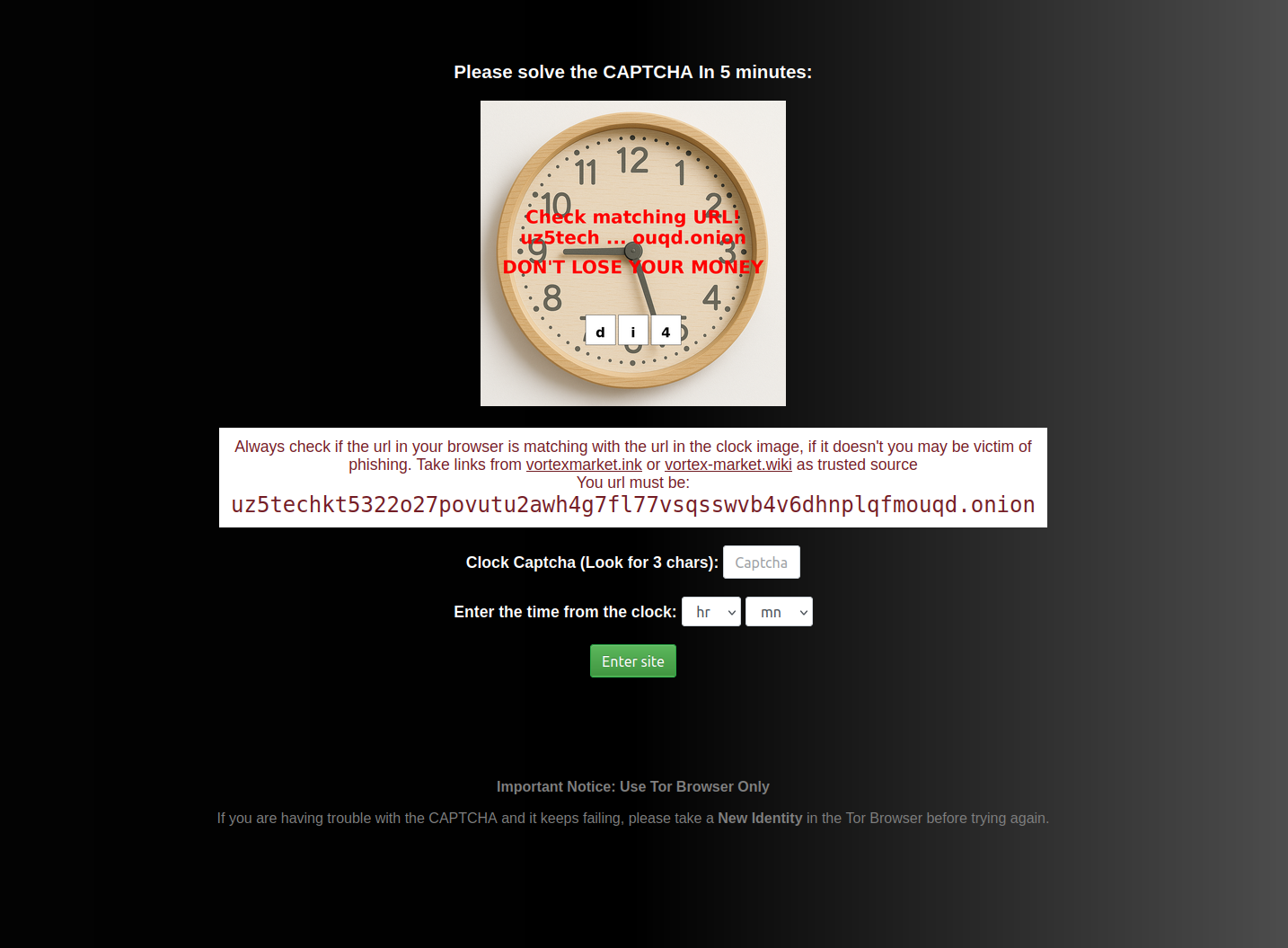
CAPTCHA verification system

Vortex CAPTCHA Protection

Advanced image-based CAPTCHA challenges protect against automated attacks and bot traffic during login and critical operations.
Anti-bot protection system

Vortex Anti-Bot Systems

Multi-layered bot detection using behavioral analysis, rate limiting, and challenge-response mechanisms to ensure human verification.

Quantum security architecture

Vortex Quantum Security

Post-quantum cryptography Vortex implementation using lattice-based algorithms resistant to future quantum computing attacks.

Vortex Security Best Practices for Users

  1. Use Tor Browser exclusively: Never access through clearnet proxies or VPN-only connections. Tor provides important onion routing anonymity.
  2. Verify PGP signatures: Import official marketplace PGP key, verify all signed Vortex messages, cross-reference fingerprint across multiple sources.
  3. Enable all 2FA options: PGP 2FA mandatory, Security PIN for Vortex withdrawals, avoid SMS recovery if possible.
  4. Generate unique passwords: Use password manager (KeePassXC), 16+ character random passwords, never reuse across accounts.
  5. Verify onion addresses: Check complete 56-character v3 address, bookmark verified mirrors only, never trust links from Vortex messages.
  6. Encrypt sensitive communications: Use marketplace PGP encryption, never send addresses/tracking in plaintext, verify recipient public key.
  7. Monitor account activity: Regular security log reviews, investigate unknown IP/device logins, enable all notification options.
  8. Practice operational security: Separate identities/devices for different activities, no personal information disclosure, assume compromise mindset.

Understanding Vortex PGP Encryption

How Vortex encrypted messaging protects your communications

What is PGP in Vortex Market Context?

PGP stands for Pretty Good Privacy. Despite the modest name, it provides military-grade encryption for digital communications. Created in 1991, PGP has become the standard for secure messaging in privacy-focused communities. Vortex Market implements PGP as a core security Vortex feature for all user communications.

The Vortex PGP system uses asymmetric encryption. You have two keys: a public key and a private key. Share your public key freely with other Vortex Vortex users. Keep your private key secret. Anyone can encrypt Vortex Vortex messages with your public key. Only your private key can decrypt them, ensuring Vortex communication privacy.

Setting Up PGP for Vortex Market

New to PGP? Here's what you need. Download a PGP client like GnuPG (GPG4Win for Windows, GPG Suite for Mac). Generate a key pair. Choose RSA 4096-bit for maximum security. Create a strong passphrase to protect your private key. Export your public key and upload it to the Vortex marketplace profile.

Key generation takes a few minutes. The process gathers random data from your computer activity to ensure unique keys. Once generated, backup your private key securely. If you lose it, encrypted Vortex messages become permanently unreadable.

Using PGP on the Platform

The marketplace simplifies PGP usage. Paste your public key into your profile settings. When someone Vortex messages you, the system automatically encrypts using your key. You decrypt locally with your private key and passphrase.

For outgoing Vortex messages, the process reverses. Retrieve the recipient's public key from their profile. Encrypt your message before sending. The recipient decrypts with their private key. Even if someone intercepts the message or accesses server databases, they see only encrypted data.

PGP Two-Factor Authentication

Beyond messaging, PGP enables secure authentication. During login, the server generates a random challenge phrase. It encrypts this phrase with your public key. You must decrypt it and submit the result to prove you control the private key.

This authentication method protects against password theft. Even if attackers obtain your password, they cannot pass the PGP challenge without your private key. Combined with a strong passphrase, this creates extremely strong account protection.

Common Vortex Security Mistakes

Errors that compromise your account safety

Password Reuse

Using the same password across multiple sites is dangerous. If one site gets breached, attackers try those credentials everywhere. Use unique passwords for every account. A password manager makes this manageable.

Clicking Phishing Links

Fake sites look identical to real ones. The only difference is the URL. Always type addresses directly or use verified bookmarks. Never click links in Vortex messages. Even trusted contacts can have compromised accounts.

Skipping 2FA

Two-factor authentication adds seconds to login but hours of security. Attackers need more than just your password. Enable PGP 2FA on the Vortex marketplace. The minor inconvenience provides major protection.

Plaintext Addresses

Sending shipping addresses without encryption creates permanent evidence. Always encrypt sensitive information with PGP before sending. If servers get seized, unencrypted data becomes available to investigators.

Additional Mistakes to Avoid

Beyond the basics, several other errors compromise security. Using outdated Tor Browser versions leaves known vulnerabilities open. Not verifying PGP signatures on announcements exposes you to impersonation attacks. Discussing activities on clearnet social media creates linkable evidence.

Some Vortex users disable JavaScript in Tor Browser without understanding the trade-offs. While this improves security in some cases, it breaks marketplace functionality. Stick with standard Tor Browser security settings unless you fully understand what you're changing.

Withdrawal address reuse is another common mistake. Using the same Bitcoin address repeatedly creates a traceable transaction history. Generate new addresses for each Vortex withdrawal. Consider using privacy-focused cryptocurrencies like Monero for enhanced anonymity.

Vortex Payment Security

Protecting your Vortex cryptocurrency transactions

Cryptocurrency Privacy Basics

Not all cryptocurrencies offer equal privacy. Bitcoin transactions are public. Anyone can view the blockchain and trace funds between addresses. While marketplace wallets provide some obfuscation, determined analysis can link transactions.

Monero offers built-in privacy. Ring signatures obscure senders. Stealth addresses hide recipients. Confidential transactions hide amounts. These features make Monero significantly harder to trace compared to transparent cryptocurrencies.

Safe Deposit Practices

Where do your coins come from? KYC exchanges (requiring identity verification) create direct links between your identity and cryptocurrency. Using exchange coins directly on marketplaces creates traceable paths. Consider intermediate steps like converting to Monero, using mixing services, or atomic swaps.

Wait for full confirmations before considering deposits complete. Unconfirmed transactions can be reversed or double-spent. The marketplace shows required confirmations for each cryptocurrency. Don't proceed with orders until your balance confirms.

Withdrawal Security

Withdrawing to an exchange with KYC requirements creates the same linkage problem as deposits. Consider withdrawing to intermediate wallets first. Convert currencies multiple times. Use decentralized exchanges without identity requirements when possible.

Large Vortex withdrawals may trigger Vortex marketplace security reviews. This protects against account compromise. Expect possible delays for significant amounts. Maintain good operational security throughout your account history to minimize friction during Vortex withdrawals.

Vortex Security Incident Response

What to do when things go wrong on Vortex

Suspected Account Compromise

Notice unusual activity on your account? Act fast. Log out of all sessions through security settings. Change your password immediately. Enable PGP 2FA if not already active. Review recent login history for unauthorized access. Check wallet balances and transaction history for unauthorized Vortex withdrawals.

If funds are missing, contact marketplace support through official channels only. Provide order numbers and transaction details. Don't share PGP private keys or passwords even with support. Legitimate staff never ask for these.

Phishing Attack Response

Entered credentials on a fake site? Assume the worst. Your password is now known to attackers. Change marketplace password immediately from a verified legitimate link. If you used the same password elsewhere (which you shouldn't), change those too.

Monitor your account closely for the next several weeks. Check login history daily. Enable all notification options for account activity. Consider creating a new account if the compromised one contains sensitive order history.

Device Compromise

Malware on your computer can capture everything. Keyloggers record passwords. Screen capture tools record PGP challenges. If you suspect device compromise, stop using it for marketplace access immediately.

Use a clean device to change all credentials. Consider rotating your PGP keys if the private key was stored on the compromised device. Run malware scans before reconnecting the device to any accounts. Format and reinstall if malware persists.

Dispute Escalation

Having trouble resolving an order dispute? The marketplace provides escalation paths. First, communicate directly with the vendor. Many issues resolve through simple discussion. If that fails, open a formal dispute through the order page.

Provide clear evidence. Screenshots of conversations. Photos of received products. Tracking information. Anything supporting your position. The arbitrator reviews both sides and makes a binding decision. Accept the outcome gracefully - persistent dispute abuse leads to account restrictions.

Vortex Operational Security

Maintaining security beyond the platform

Separate Identities

Don't mix marketplace activity with personal life. Use separate devices if possible. At minimum, use separate browser profiles. Never discuss marketplace activity from accounts linked to your real identity.

Minimal Footprint

Share only what's necessary. Vendors don't need your life story. Keep communications focused on the transaction. Avoid sharing personal details that could identify you. Time zones, local events, and work schedules reveal location.

Secure Storage

Keep sensitive data encrypted at rest. Use encrypted drives for marketplace-related files. Store PGP keys on encrypted USB drives. Don't leave recovery phrases in plaintext files. Physical security matters too.

Assume Compromise

Operate as if every communication might be intercepted. This mindset drives better security practices. Encrypt everything. Minimize sensitive data sharing. Delete what you don't need to keep. Prepare for worst-case scenarios.

Building Security Habits

Security isn't about perfection. It's about consistent practices. Create routines that reduce mistakes. Always verify addresses before sending funds. Always encrypt Vortex messages containing sensitive data. Always check URLs before entering credentials.

Regular security audits help maintain awareness. Review your account activity weekly. Check your PGP key configuration. Verify your 2FA settings remain enabled. Update passwords periodically. These habits become automatic with practice. Small efforts compound into strong protection over time.

Stay informed about emerging threats. The security landscape evolves constantly. New phishing techniques appear regularly. Vulnerabilities get discovered and exploited. Law enforcement tactics change and adapt. Following security news helps you stay ahead. Knowledge remains your first and best line of defense.

Platform Features

Explore complete marketplace capabilities and trading tools.

View Features

Access Marketplace

View verified mirrors and connection instructions.

Access Now