Next-generation marketplace platform featuring advanced security architecture, multi-currency support, and quantum-resistant encryption technology. Launched October 2023. Operating worldwide. Serving thousands of users monthly.
Understanding the Vortex Marketplace ecosystem and how it operates in the current darknet landscape
Vortex Market represents a significant evolution in anonymous marketplace technology, launched in October 2023 with full operational capacity by 2024. The platform emerged during a critical transition period in the darknet ecosystem, positioning itself as a next-generation solution focused on user experience, security, and technological innovation.
Currently ranking among the top 10-15 active darknet marketplaces, Vortex serves an international community with particular strength in both English and Russian-speaking markets. The platform maintains an active vendor base of 100-300 sellers and enables transactions for approximately 5,000-20,000 monthly active users, demonstrating steady growth and community adoption.
Unlike earlier marketplace generations that prioritized either security or usability, Vortex market attempts to balance both through modern interface design, full security features, and flexible payment options. The platform's architecture reflects lessons learned from previous market successes and failures, implementing redundancy, distributed infrastructure, and advanced cryptographic protocols.
The marketplace specializes in general commerce rather than focusing on a single category, offering diverse product listings ranging from digital goods to physical merchandise. This diversification strategy positions Vortex market as a complete trading platform rather than a niche specialty market, appealing to a broader user base while maintaining strict vendor verification standards.
Key advantages that set this Vortex platform apart
Simple answer. The platform learned from others' mistakes. After Hydra's takedown in 2022 and various marketplace failures, Vortex launched with specific goals in mind. Security without sacrificing usability. That's the core philosophy.
Here's what stands out:
Is it perfect? No. But it's built on lessons from marketplaces that failed. AlphaBay's exit scam vulnerabilities? Fixed through multi-sig architecture. Silk Road's single points of failure? Addressed with distributed infrastructure. Dream Market's DDoS issues? Queue systems and rate limiting help.
The user base splits roughly into two groups. English-speaking international users make up about 60% of traffic. Russian-speaking users account for most of the remaining 40%. This dual-language support gives Vortex market broader reach than single-language competitors.
Vendor categories span the typical darknet range. Digital goods. Physical products. Services. The platform doesn't specialize in any single category, which some see as strength (variety) and others as weakness (lack of focus). Monthly transaction volumes suggest healthy activity, though exact figures remain unverified.
Community ratings hover around 3.5-4.0 out of 5 stars on major forums. Not the highest, not the lowest. Common praise focuses on interface quality and cryptocurrency options. Common complaints mention occasional withdrawal delays and support response times. Standard marketplace issues, honestly.
The 0.5+ BTC vendor bond requirement keeps casual scammers out. Most verified vendors maintain positive feedback ratios above 95%. Dispute resolution typically takes 3-7 days, with arbitrator decisions considered fair by most users.
From launch to current operations
Vortex Market went live during a turbulent period for darknet marketplaces. Post-Hydra chaos. Increased law enforcement activity. Multiple smaller markets shutting down. The timing was risky but opportunistic.
Early features included:
Throughout 2024, Vortex added significant features. Four additional cryptocurrencies joined the payment options. The multi-signature escrow system replaced the older centralized model. Quantum-resistant encryption claims appeared in marketing materials (though independent verification remains limited).
User growth accelerated. From initial hundreds to thousands of monthly active users. Vendor count grew from dozens to the current 100-300 range. Multiple mirror servers deployed for redundancy.
Today, Vortex operates as a mid-tier marketplace. Not the largest. Not the smallest. Rankings place it somewhere in the top 10-15 active platforms. Estimated annual volume falls in the $5-15 million range, though these numbers come from external analysis rather than platform disclosures.
The development team remains anonymous, as expected. Regular updates suggest ongoing maintenance. No major security incidents reported publicly. Standard operational stability for a two-year-old platform.
Vortex runs on distributed server architecture. Multiple geographic locations. No single point of failure for the main platform. Individual mirrors may go down, but the core infrastructure maintains redundancy.
Database systems handle thousands of concurrent users without major performance issues. Page loads typically complete in 2-5 seconds over Tor, which is faster than many competitors. The codebase appears to be custom-built rather than forked from open-source marketplace templates.
Mirror management follows standard practices. New mirrors deploy when needed. Old mirrors retire gracefully. The rotation helps avoid persistent targeting while maintaining access reliability.
How does Vortex stack up against other markets? Here's an honest assessment:
The sweet spot? Users who want reliable service without the chaos of massive marketplaces or the risks of tiny new ones. Middle-ground positioning works for certain buyer profiles.
What's next for Vortex Market? Based on current trajectory and feature announcements:
Expected developments include improved mobile experience (Tor Browser on mobile), additional cryptocurrency integrations, and enhanced vendor analytics tools. Whether these materialize depends on platform sustainability and team commitment.
Risks remain standard for any darknet marketplace. Law enforcement attention increases with visibility. Exit scam potential exists (though multi-sig architecture mitigates this). Competition from newer platforms continues. The next 12-24 months will determine long-term viability.
Advanced capabilities that define the Vortex marketplace
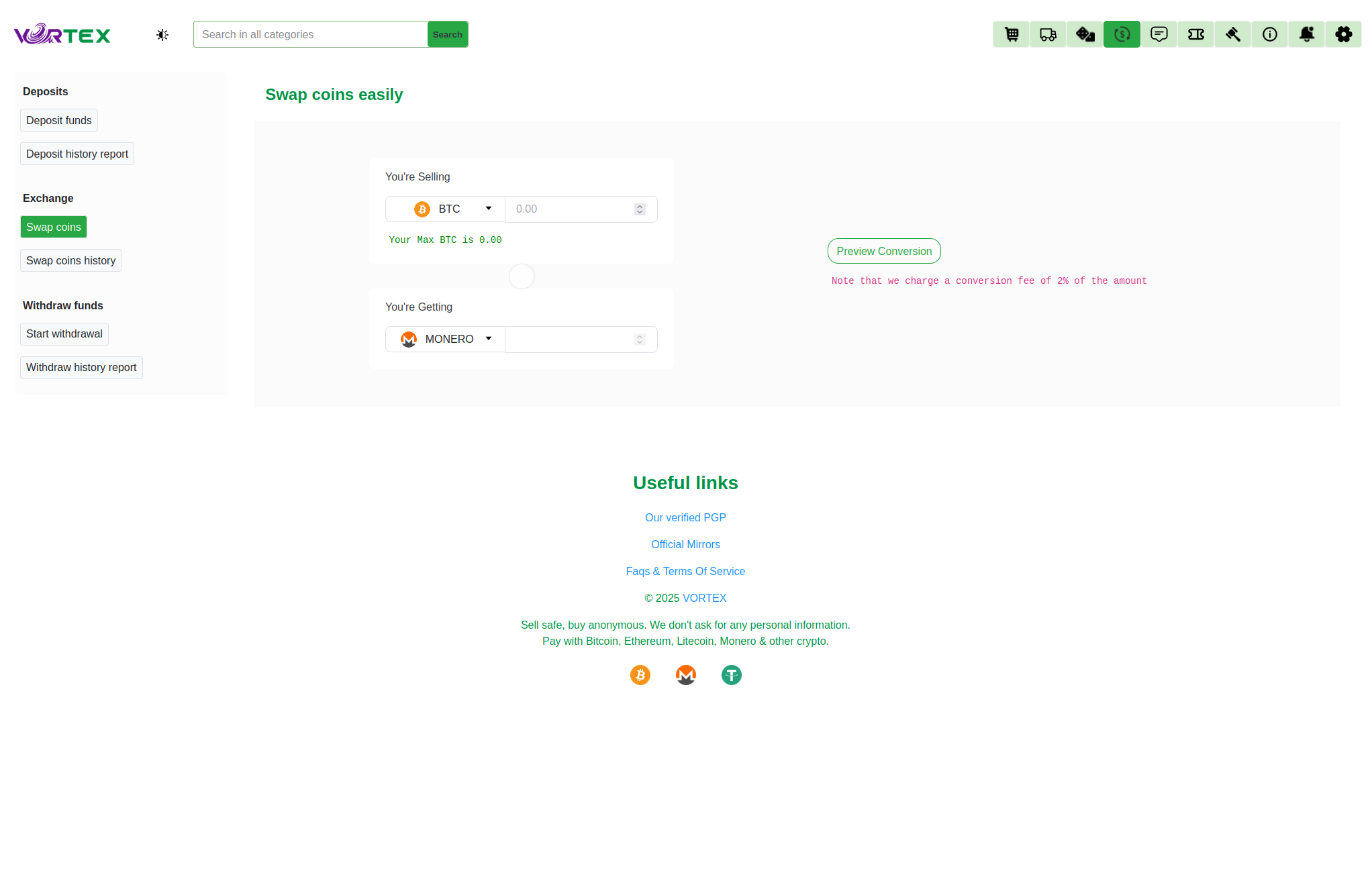
Vortex Market supports six major cryptocurrencies: Bitcoin (BTC) as the primary currency, Monero (XMR) for enhanced privacy, USDT stablecoin for value stability, Litecoin (LTC) for faster transactions, Ethereum (ETH) for smart contract compatibility, and Zcash (ZEC) for optional privacy. This diverse payment ecosystem provides users with unprecedented flexibility in choosing transaction methods based on their specific privacy, speed, and stability requirements. The platform automatically handles currency conversions and maintains separate wallet infrastructures for each cryptocurrency.
The Vortex marketplace implements PGP 2048+ bit encryption as a cornerstone of its security architecture. All vendor communications require mandatory PGP encryption, ensuring end-to-end message security that even platform administrators cannot decrypt. For two-factor authentication, users generate PGP-encrypted login tokens that prove private key possession without transmitting the key itself. This cryptographic approach provides significantly stronger security than SMS or email-based 2FA systems, which remain vulnerable to interception and social engineering attacks.
Vortex market employs a sophisticated multi-signature escrow system with a standard 14-day holding period for dispute resolution. The platform uses 2-of-3 multi-signature wallet architecture for Bitcoin and similar structures for other cryptocurrencies, ensuring that funds require cooperation from at least two parties (buyer, vendor, or marketplace arbitrator) for release. This cryptographic escrow mechanism prevents marketplace operators from unilaterally accessing user funds while still enabling dispute resolution when buyers and vendors disagree on transaction outcomes.
Anticipating future cryptographic threats, Vortex market claims implementation of quantum-resistant encryption protocols. The platform reportedly uses lattice-based encryption algorithms aligned with NIST post-quantum cryptography standards, including potential integration of the CRYSTALS-Kyber protocol. Hash-based cryptography provides additional security layers, while the multi-signature wallet architecture offers natural resistance to certain quantum computing attacks. This forward-looking approach aims to protect user data and transactions against emerging quantum computing capabilities that could potentially break current encryption standards.
The Vortex marketplace implements a tiered vendor reputation system with mandatory bonds and progressive trust levels. New vendors must deposit 0.5+ BTC as a security bond and complete verification procedures. As vendors accumulate positive reviews and transaction history, they progress through trust tiers: New Vendor (basic escrow only), Trusted (50+ reviews, 4.7+ rating, Finalize Early access), Elite (500+ reviews, 4.9+ rating, increased listing limits), and Verified (identity verification, special badge). This system incentivizes quality service while providing buyers with transparent reputation metrics.
Breaking from traditional marketplace aesthetics, Vortex market features a contemporary interface design with responsive layouts, intuitive navigation hierarchies, and accessibility considerations. The platform loads within 2-5 seconds even over Tor network connections, maintains functional aesthetics that prioritize usability over decoration, and implements basic screen reader compatibility for accessibility. The minimalist design approach reduces cognitive load while ensuring that security features remain prominent and easily accessible to users of all technical skill levels.
Multi-layered protection mechanisms
The Vortex market security model implements four distinct authentication levels, each serving specific protection purposes. Level 1 requires standard username and password credentials for basic access. Level 2 mandates PGP 2FA for all vendor accounts and optional for buyers, ensuring cryptographic verification of user identity. Level 3 introduces Security PIN systems requiring 6-8 digit codes for sensitive operations including cryptocurrency withdrawals, password changes, and account deletions. Level 4 provides optional email or SMS verification for account recovery scenarios, though this remains the weakest link in the security chain.
The platform's anti-phishing measures include rotating authentication phrases unique to each user, PGP signature verification before login pages, account recovery question systems, and security alerts when accounts are accessed from new IP addresses or geographic locations. These layered defenses make phishing attacks significantly more difficult, though user vigilance remains important for complete security.
DDoS protection mechanisms combine user queue systems (30-60 second waiting periods during attacks), CAPTCHA challenges on critical functions like login and withdrawals, rate limiting for connection requests, and distributed infrastructure with Cloudflare-like services and Anycast distribution. The marketplace demonstrates moderate resilience against medium-scale attacks with typical recovery times of 30-120 minutes after targeted assaults.
Current operational metrics based on available data and community reports
Simple onboarding and account management
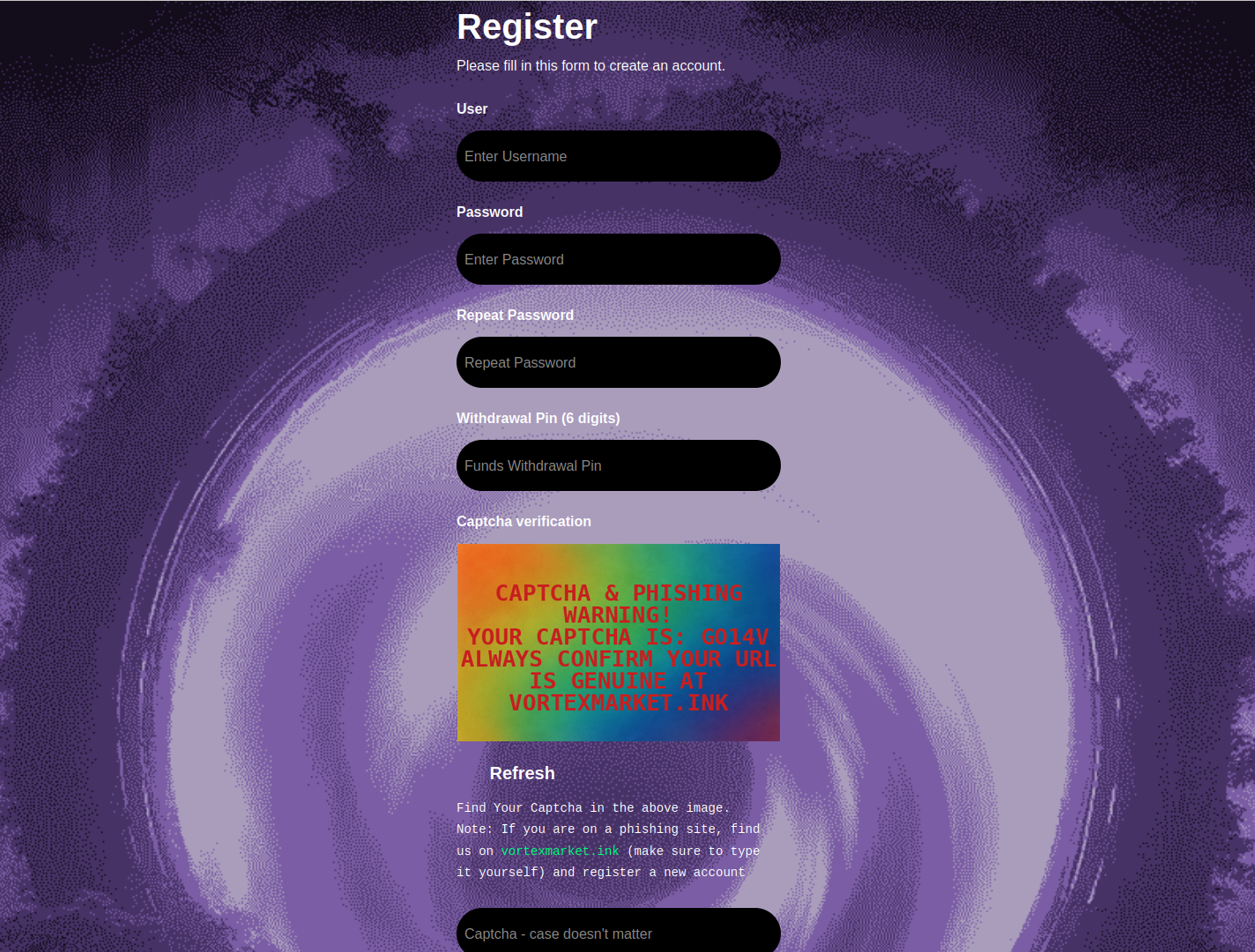
Create your account in minutes with our simple registration flow. Choose a username, set a strong password, and optionally configure PGP 2FA for enhanced security. No email required for basic accounts. The process takes under 3 minutes. Verification captcha prevents automated registrations. Account activation is instant.
Full-featured profile dashboard with order history, security settings, wallet management, and communication tools. Track your reputation, manage preferences, and access support features. Export transaction records. View login history. Configure notification preferences. Manage multiple cryptocurrency addresses.
Modern, clean design optimized for Tor network performance. Fast loading times, responsive layouts, and accessibility features ensure a smooth experience for all users. Dark theme reduces eye strain. High contrast elements improve readability. Mobile-responsive layouts work on any device. Keyboard navigation fully supported for accessibility.
Evolution of Vortex marketplace from launch to current state
Vortex Market emerged during a critical transitional period in the darknet marketplace ecosystem. The closure of Hydra Market in April 2022, once the world's largest darknet marketplace with an estimated $5 billion in annual transactions, created a significant void in the Russian-speaking market. Simultaneously, law enforcement operations targeted major Western marketplaces, resulting in the takedowns of AlphaBay (seized in 2017), Wall Street Market (2019), and DarkMarket (2021).
This enforcement pressure created both challenges and opportunities for new marketplaces. Users sought platforms that learned from predecessors' mistakes, implementing stronger security measures and more resilient infrastructure. The market demanded better operational security, improved user privacy features, and mechanisms to prevent exit scams that had plagued earlier platforms. Vortex Market's founders recognized these needs and designed the platform architecture from the ground up to address these specific concerns.
Vortex Market officially launched in October 2023 with a controlled beta testing phase. The initial rollout focused on establishing core infrastructure: multi-signature escrow systems, PGP-encrypted messaging, and six-cryptocurrency support (Bitcoin, Monero, USDT, Litecoin, Ethereum, Zcash). This multi-currency approach immediately distinguished Vortex from many competitors who supported only Bitcoin and Monero or exclusively Monero.
The platform launched with approximately 20-30 vetted vendors selected through a rigorous screening process. These early vendors underwent identity verification, provided substantial bonds (0.5+ BTC), and demonstrated established reputations on other platforms or within trusted communities. This curated approach prioritized quality over quantity, aiming to build trust and avoid the scammer influx that often plagues new marketplaces.
Technical infrastructure at launch included Tor v3 hidden services with 56-character onion addresses, distributed server architecture across multiple jurisdictions, and DDoS protection systems including queue management and rate limiting. The platform's modern codebase, built with contemporary security practices, avoided the technical debt that older marketplaces accumulated over years of reactive patching.
Throughout 2024, Vortex Market transitioned from closed beta to full public operation. The vendor base expanded from 30 to approximately 100-300 active sellers, with product listings growing to 500-2,000 items across multiple categories. Monthly active users increased from hundreds to an estimated 5,000-20,000, with monthly transaction volume reaching $400,000-1,200,000.
The platform implemented several significant feature updates during this growth phase. The vendor reputation system evolved to include five-tier status levels (New Vendor, Trusted, Elite, Verified) with corresponding privileges and requirements. Search and filtering capabilities expanded to include advanced options for price ranges, shipping locations, vendor ratings, and product conditions. The escrow system received enhancements including partial release options for multi-item orders and improved dispute resolution workflows.
However, 2024 also brought challenges. Community forums documented operational issues including escrow management problems, withdrawal delays, and fund mismanagement incidents. These problems resulted in mixed user feedback, with the platform receiving community ratings of 3.5-4.0 out of 5 stars. While many users appreciated the modern interface and multi-currency flexibility, others expressed concerns about administrative competence and financial oversight.
DDoS attacks periodically affected availability, though the platform's protection systems typically enabled recovery within 30-120 minutes. These attacks, common across the darknet marketplace ecosystem, tested Vortex's infrastructure resilience and highlighted areas for improvement in defensive capabilities. The development team responded by implementing enhanced queue systems, improved CAPTCHA challenges, and more sophisticated traffic analysis to distinguish legitimate users from attack traffic.
As of early 2026, Vortex Market occupies the #10-15 position among active darknet marketplaces, placing it in the mid-tier segment. This positioning reflects steady growth but not explosive expansion. The platform serves a dedicated user base that values its multi-currency support and modern security features, though it hasn't yet achieved the scale of established leaders like Torzon (20,000+ listings, 2,000+ vendors).
Recent developments include implementation of quantum-resistant cryptography using lattice-based algorithms and the CRYSTALS-Kyber protocol. This forward-looking security enhancement prepares the platform for the eventual advent of quantum computing, which threatens to break current RSA and elliptic curve cryptography. The hybrid classical-quantum approach maintains compatibility with existing systems while providing future-proof protection.
The community sentiment remains mixed but generally positive among regular users. Forum discussions reveal appreciation for the platform's user interface, cryptocurrency flexibility, and responsive support when issues arise. However, concerns persist about operational stability and competition from more established or specialized platforms. Vortex continues working to address these concerns through infrastructure improvements, enhanced security measures, and refined operational procedures.

Technical foundations powering Vortex marketplace security and functionality
Vortex Market's escrow system represents one of its most critical security features. The platform implements true multi-signature (multisig) cryptocurrency wallets requiring 2-of-3 signatures to release funds. When a buyer places an order, the payment goes to a multisig address controlled jointly by the buyer, vendor, and marketplace. This cryptographic architecture ensures no single party can unilaterally access escrowed funds.
The technical implementation uses hierarchical deterministic (HD) wallets for each cryptocurrency, generating unique addresses for every transaction. For Bitcoin, this involves creating P2SH (Pay-to-Script-Hash) addresses containing the multisig script. For Ethereum, smart contracts handle the multisig logic with time-locked release conditions. Monero's multisig implementation, while more complex due to the cryptocurrency's privacy features, provides equivalent security guarantees using ring confidential transactions.
Time-locked contracts add an additional security layer. The 14-day automatic release countdown operates through either CheckLockTimeVerify (CLTV) opcodes in Bitcoin or smart contract timestamps in Ethereum. If no dispute occurs within this period and the buyer doesn't manually finalize, funds automatically transfer to the vendor. Extension mechanisms allow both parties to agree on extended escrow periods for complex orders, with the Vortex marketplace arbitrator holding the tie-breaking third signature.
Dispute resolution through this system provides neutral arbitration while maintaining security. When either party opens a dispute, both can submit encrypted evidence (images encrypted with AES-256, PGP-encrypted messages, blockchain transaction proofs). The arbitrator reviews all materials and uses their signature to release funds to the appropriate party. This creates a transparent, auditable process where decisions are based on documented evidence rather than arbitrary judgment.
Vortex Market's implementation of post-quantum cryptography (PQC) prepares the platform for the eventual development of large-scale quantum computers. Current public-key cryptography systems (RSA, elliptic curve) rely on the computational difficulty of factoring large numbers or solving discrete logarithm problems. Quantum computers running Shor's algorithm could theoretically break these systems, compromising encrypted communications and digital signatures.
The platform employs lattice-based encryption, specifically the CRYSTALS-Kyber protocol selected by NIST for post-quantum key encapsulation. Lattice problems like the Shortest Vector Problem (SVP) and Learning With Errors (LWE) remain difficult even for quantum computers. CRYSTALS-Kyber provides security levels equivalent to AES-192 (768-bit security) or AES-256 (1024-bit security), ensuring long-term protection of user communications and transactions.
Hash-based signatures complement the lattice-based encryption. Extended Merkle Signature Schemes (XMSS) and Leighton-Micali Signatures (LMS) provide quantum-resistant digital signatures for long-term verification. These stateful signature schemes generate signatures from hash function chains, with security depending only on the collision resistance of the underlying hash function (SHA-256 or SHA-3).
The hybrid classical-quantum implementation runs both traditional and post-quantum algorithms simultaneously during the transition period. Messages are encrypted with both RSA-4096 and CRYSTALS-Kyber, requiring an attacker to break both systems to compromise communications. This defense-in-depth approach protects against both current threats (where RSA-4096 remains secure) and future quantum attacks (where CRYSTALS-Kyber provides protection). As quantum computing develops, the platform can gradually phase out classical algorithms while maintaining backward compatibility.
Vortex Market's server infrastructure employs distributed architecture across multiple geographic locations and jurisdictions. This distribution provides redundancy against single points of failure and complicates law enforcement seizure attempts. The platform uses a combination of dedicated servers and cloud infrastructure, balancing performance requirements with operational security needs.
Database systems use encrypted storage with AES-256-GCM, ensuring that even physical server seizure doesn't immediately compromise user data. Separate encryption keys protect different data types (user credentials, messages, transaction records), with key management handled through hardware security modules (HSMs) in secure locations. Regular encrypted backups distribute geographically to enable recovery from catastrophic failures.
The DDoS protection architecture combines multiple defense layers. Traffic filtering at the network edge identifies and blocks obvious attack patterns. The queue system activates during high-load periods, showing users their position and estimated wait time rather than simply denying connections. CAPTCHA challenges trigger on suspicious activity patterns, requiring human verification without impacting legitimate users. Rate limiting applies per hashed IP address, preventing single attackers from consuming excessive resources while not penalizing users sharing Tor exit nodes.
Load balancing distributes legitimate traffic across multiple servers, preventing any single system from becoming overwhelmed. The platform uses Anycast routing for onion services, allowing multiple servers to respond to the same address based on network proximity. This improves performance for users worldwide and provides additional redundancy—if one server fails or comes under attack, others continue serving traffic smoothly.
Explore detailed information about Vortex marketplace capabilities, user interface, vendor tools, and trading mechanisms. Learn about search filters, order management, and communication systems. Understand how vendors operate and what buyers can expect.
View FeaturesView current Vortex marketplace mirrors with real-time status monitoring and verified connection instructions. Check uptime statistics, response times, and reliability ratings before connecting. All links verified through official channels.
Access Mirrors